


How to Brew Better Coffee: A Guide to Better Mornings
Table of Contents
- Why Your Coffee Tastes Off (And How to Fix It)
- Start With Fresh Whole Beans and the Right Grind
- The Coffee-to-Water Ratio That Changes Everything
- How to Brew Coffee With a Coffee Maker (Step by Step)
- Water Temperature and Quality: The Invisible Ingredients
- Troubleshooting Sour, Bitter, Weak, and Harsh Coffee
- How to Store Coffee Beans So They Stay Fresh Longer
- Cleaning Your Equipment for Consistently Better Coffee
- Frequently Asked Questions
Last Updated: October 16, 2026
Why Your Coffee Tastes Off (And How to Fix It)
If your morning cup tastes sour, bitter, or flat, the problem is almost never the coffee itself, it is one of four brewing variables you control. This guide from Shamballa Caffe walks through each one, so you can learn how to brew better coffee at home without buying a new gadget.
Great coffee is a skill, not a talent: once you understand each variable, you can adjust any cup to your taste in seconds.
The Four Variables That Control Every Cup
Coffee extraction is the process of dissolving flavor compounds from ground coffee into water. Four things control it:
- Grind size - how fast water pulls flavor from the grounds
- Coffee-to-water ratio - how strong the final cup tastes
- Water temperature - how much flavor the water can extract
Change one, and the cup changes.
Start With Fresh Whole Beans and the Right Grind
Freshness and grind size matter more than any expensive machine. Whole beans keep their flavor for weeks; pre-ground coffee starts losing aroma within days. Buy whole beans and grind right before you brew. A burr grinder gives you even particles and even extraction; blade grinders chop unevenly, so some grounds over-extract while others stay raw.
Matching Coffee Grind Size to Your Brew Method
Each brew method needs a different grind size. Here is the range, from finest to coarsest:
| Brew Method | Grind Size | Brew Time |
|---|---|---|
| Espresso | Fine | 25-30 seconds |
| Drip coffee maker | Medium | 4-6 minutes |
| Pour-over | Medium-fine | 3-4 minutes |
| French press | Coarse | 4 minutes steep |
| Cold brew | Extra coarse | 12-24 hours |
A simple rule: the longer the water touches the coffee, the coarser the grind. Cold brew steeps up to 24 hours and needs the coarsest setting; espresso pushes water through in seconds and needs the finest.
The Coffee-to-Water Ratio That Changes Everything
The coffee-to-water ratio is the single biggest lever on flavor. Start at 1 gram of coffee to 16 grams of water, or 16:1, about 2 tablespoons per 6 ounces of water. Move toward 1:15 for stronger, 1:17 for lighter; most people find their sweet spot within three or four brews.
How to Measure Coffee and Water Without a Scale
A digital scale is most accurate and costs less than a bag of beans, but you can get close without one:
- Use 2 level tablespoons of ground coffee per 6 ounces of water
- Fill your mug with water first, then pour that amount into the reservoir
- Keep the scoop level, not heaped
For reference, 60 grams per liter equals 16:1, and an 8-ounce cup needs roughly 15 grams.
How to Brew Coffee With a Coffee Maker (Step by Step)
A drip coffee maker can make excellent coffee if you control the variables instead of letting the machine decide.
- Fill the reservoir with fresh, filtered cold water. Use the markings, or measure 6 ounces per cup.
- Weigh or scoop your coffee. Aim for 2 tablespoons per 6 ounces of water.
- Grind to a medium setting. If you buy pre-ground, choose a drip-specific grind.
- Add a paper or mesh filter and spread the grounds evenly.
- Start the brew. If your machine has a "bold" setting, use it for a slower, fuller extraction.
- Stir the grounds once at the start if your machine allows it. This evens out extraction.
- Serve immediately. Coffee sitting on a hot plate turns bitter within 20 minutes.
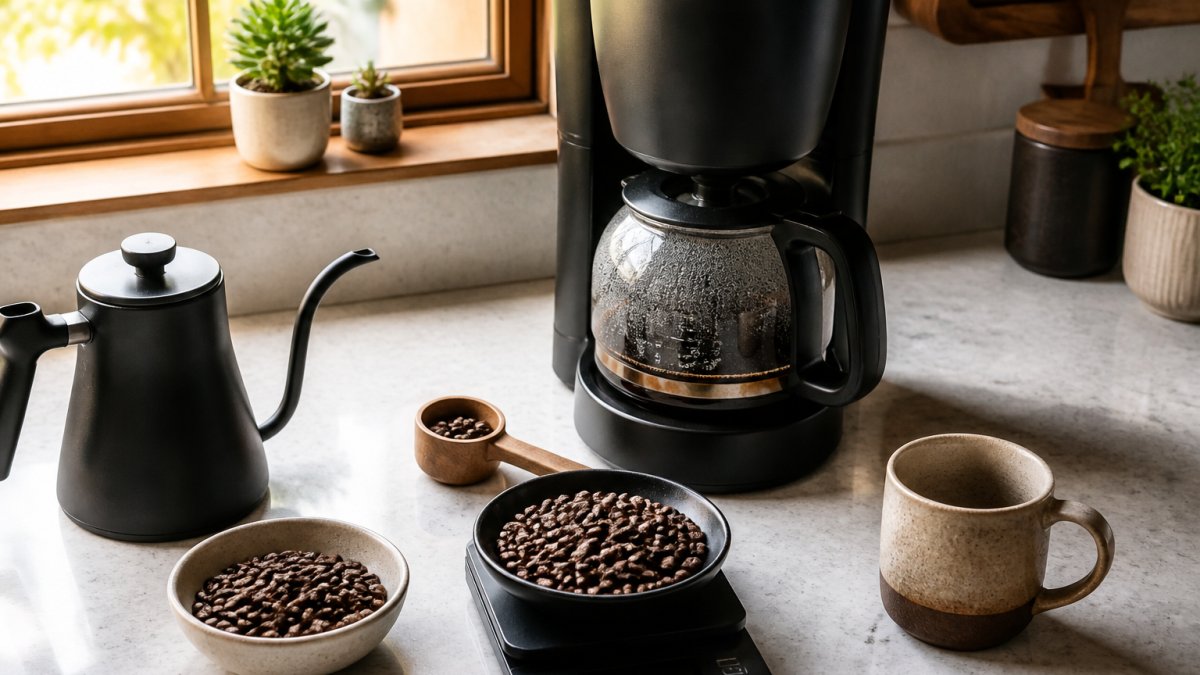
Expected result: A balanced cup with no sour edge and no burnt aftertaste. If it is close, adjust the grind one notch.
Water Temperature and Quality: The Invisible Ingredients
Water makes up roughly 98% of your brewed coffee, making it the largest single ingredient in the cup. Water chemistry and temperature are two of the most controllable variables in home brewing, and two of the most common hidden causes of flat, sour, or bitter coffee.
Temperature: The Extraction Dial You Cannot See
The widely cited target range is 195°F to 205°F, just below a rolling boil. Within it, water dissolves sugars, acids, and aromatics at a predictable rate without driving off volatile aromatics or pulling out harsh, drying compounds:
- Below roughly 195°F, extraction slows. Acids and fruity notes come out first, sugars and caramelized compounds lag behind. The result is a cup that tastes sour, thin, or sharply acidic even when the grind and ratio are correct.
- Above roughly 205°F, extraction accelerates past the point of balance. You strip out the bitter, astringent compounds that normally stay bound in the grounds, and you lose delicate aromatics to steam. The result is a harsh, drying, sometimes ashy cup.
- Inside the range, extraction is even and repeatable. This is why the same beans can taste completely different from two machines that brew at different temperatures.
A common pattern: a drip machine rated for 195°F to 205°F brews cooler as it ages, because mineral scale on the heating element insulates it. If your coffee has gotten weaker or more sour over months without any change to beans or grind, temperature drift is a prime suspect, a cheap instant-read thermometer in the carafe mid-brew will confirm it.
For manual brewing, bring water to a full boil, then let the kettle rest:
- 30 to 45 seconds off the boil drops water into roughly the 195°F to 205°F window at sea level.
- At higher elevations, water boils cooler, so the rest time shortens. At 5,000 feet, water boils near 203°F, already inside the target range, so pour immediately.
Water Chemistry: What Is Actually in the Water
Filtered water is the standard advice, but the reason matters. Two things shape extraction: mineral content and anything that competes with coffee for your palate.
Minerals do work. Magnesium and calcium ions bind to flavor compounds and carry them into the cup.
Chlorine and chloramine are the other common problem.
A simple home test: brew two identical cups, one tap and one filtered, using the same beans, grind, ratio, and temperature.
For general guidance on what is in drinking water and how it varies by region, the Environmental Protection Agency's water information publishes consumer resources, and the Water Quality Association covers home filtration options.
Matching Water to Roast and Grind
Water temperature and grind size push extraction in the same direction, so adjusting both at once is the fastest way to lose track of what worked.
- Light roasts are denser and less soluble, so they reward the hotter end (near 205°F) and a slightly finer grind.
- Dark roasts are more porous and extract quickly, so they taste best at the cooler end (near 195°F) and a slightly coarser grind.
- If you change water temperature, do not change grind in the same brew. Pick one variable, taste, then decide.
Understanding water turns temperature and chemistry from invisible background conditions into levers you can pull on purpose.
Troubleshooting Sour, Bitter, Weak, and Harsh Coffee
Most bad cups fall into four taste categories, each pointing to a specific adjustment. The table is the quick reference; the rest of this section explains how to diagnose a cup in the right order.
| Taste Problem | Likely Cause | First Fix | Second Fix |
|---|---|---|---|
| Sour, sharp, acidic | Under-extracted | Grind finer | Raise water temperature or extend brew time |
| Bitter, dry, astringent | Over-extracted | Grind coarser | Lower water temperature or shorten brew time |
| Weak, watery, hollow | Too little coffee for the water | Tighten ratio toward 1:15 | Check that grind is not too coarse |
| Harsh, burnt, ashy | Water too hot or beans over-roasted | Let water cool before pouring | Try a lighter roast |
The Diagnostic Order That Saves Beans
When a cup tastes wrong, the instinct is to change everything at once, the fastest way to waste a bag of coffee. Work through the variables in this order, changing one thing per brew:
- Ratio first. If the cup is weak or watery, the problem is usually not extraction, it is simply too little coffee for the water. Tighten from 16:1 toward 15:1 before you touch the grinder. A weak cup that is also sour is a ratio problem; a weak cup that is also bitter is an extraction problem.
- Grind second. Once the ratio is right, sour means grind finer and bitter means grind coarser. Move one setting at a time. On a stepped grinder, that is one click; on a stepless grinder, a small nudge.
- Temperature third. If grind adjustments are not moving the taste, check water temperature. Cool water mimics under-extraction (sour, thin) and hot water mimics over-extraction (bitter, harsh). This is the variable most home brewers never check.
- Time last. Brew time is usually a consequence of grind size, not an independent lever. If you grind finer, the brew naturally takes longer. Only adjust time directly if your method lets you, for example, cutting a French press steep short, or extending a pour-over.
Reading the Cup Like a Diagnostician
Sour and bitter point in opposite directions but are frequently confused because both feel unpleasant. Here is how to tell them apart:
- Sour hits the sides of your tongue and the back of your jaw. It feels sharp, bright, and sometimes fruity in a way that is almost pleasant but too intense. It fades quickly.
- Bitter sits at the back of your throat and lingers. It feels drying, like the sensation after strong black tea. It does not fade, it builds.
If you cannot tell which you are tasting, let the coffee cool and taste again. Sourness intensifies as coffee cools; bitterness becomes more pronounced and drying. Cooling a cup is one of the most reliable diagnostic tools in coffee, and it costs nothing.
When the Problem Is Not the Brew
Some taste problems cannot be fixed by adjusting grind, ratio, temperature, or time. Watch for these:
- Stale, cardboard, or papery flavor. The beans are old or were stored poorly. No brewing adjustment will bring back freshness. See the storage section for how to prevent this.
- Rancid or oily aftertaste. Your equipment needs cleaning. Old coffee oils in the carafe, filter basket, or grinder turn rancid and contaminate every subsequent brew.
- Consistently flat, hollow cup regardless of adjustment. Your water may be too soft (low mineral content) or your grinder may be producing too many fines and boulders. A burr grinder upgrade often fixes what no recipe change can.
A Repeatable Calibration Routine
The goal of troubleshooting is not to fix one cup, it is to build a repeatable recipe. Once a combination tastes right, record four numbers: coffee weight in grams, water weight in grams, grind setting, and water temperature. Brew it three times without changing anything.
A scale and a timer turn brewing from a guessing game into a repeatable process, and they are the two cheapest upgrades in coffee.
How to Store Coffee Beans So They Stay Fresh Longer
How to store coffee beans comes down to three enemies: air, light, and heat. Beat all three and your beans stay fresh for weeks.
- Keep beans in an airtight, opaque container
- Store at room temperature, away from the stove and sunny windows
- Skip the freezer for daily-use beans; moisture and odors creep in
Whole beans hold their flavor far longer than grounds. That is why we roast in small batches and ship fast at Shamballa Caffe: the shorter the trip from roast to cup, the better the cup. For guidance on safe food storage at home, the USDA Food Safety and Inspection Service offers practical advice.
Cleaning Your Equipment for Consistently Better Coffee
Old coffee oils turn rancid and ruin every cup that follows. Cleaning is the least exciting and most underrated step.
- Rinse your carafe and filter basket daily
- Wash the reservoir and lid weekly with warm soapy water
- Run a vinegar or descaling solution through the machine every one to three months
Hard water leaves mineral scale that blocks proper heating, which drags brew temperature down. If your machine has never been descaled, that alone may explain why your coffee tastes weak. The Environmental Protection Agency's water information explains how water hardness varies by region.
Frequently Asked Questions
What is the best coffee-to-water ratio for brewing?
Start with a 1:16 ratio by weight, which means roughly 15 grams of coffee for every 250 milliliters (about 8 ounces) of water. This produces a balanced cup that suits most drip machines, pour-over setups, and French presses. If you prefer stronger coffee, tighten the ratio to 1:15 or 1:14. For a lighter, milder cup, loosen it toward 1:17. Weighing both coffee and water on a kitchen scale gives you repeatable results, so you can adjust one variable at a time instead of guessing.
How coarse or fine should coffee grounds be?
Coffee grind size should match your brew method and its contact time. Use a coarse grind for French press and cold brew, a medium grind for drip coffee makers and pour-over, and a fine grind for espresso. A burr grinder produces more consistent particles than a blade grinder, which matters because uneven grounds extract at different rates and create both sour and bitter notes in the same cup. If your coffee tastes weak or sour, grind finer. If it tastes bitter or harsh, grind coarser.
How can you make coffee taste less bitter?
Bitterness usually comes from over-extraction, so adjust one variable at a time. Try a coarser coffee grind size, shorten the brew time, or lower your water temperature to between 195°F and 205°F. Check that you are not using too much coffee for the amount of water. Old or stale beans also taste harsh, so buy whole beans with a recent roast date and store them in an airtight container away from light and heat. Cleaning your equipment removes built-up oils that add a bitter edge.
How should you store coffee beans to keep them fresh?
Keep whole beans in an airtight, opaque container at room temperature, away from light, heat, and moisture. Do not store them in the refrigerator, where temperature swings and odors transfer into the beans. A cool pantry shelf works well. Buy in quantities you will finish within two to four weeks of the roast date, and grind right before brewing. For longer storage, freeze beans in a sealed bag and let them come to room temperature before grinding, which preserves flavor far better than leaving them exposed on the counter.
Better coffee is not about buying more gear. It is about controlling four variables, keeping your beans fresh, and cleaning up after yourself. That is how you brew better coffee, cup after cup.
At Shamballa Caffe, we make that easier with premium beans roasted for freshness, artisan blends selected for rich flavor, and fast delivery straight to your door. Every cup becomes a small ceremony. Get started with Shamballa Caffe and turn your morning routine into a better coffee moment.