


Premium Tea Delivery Compared for Wellness Enthusiasts
Quick Summary
Premium tea delivery is best chosen by caffeine content, ingredient transparency, and per-cup cost. Shamballa Caffe's lineup prices Matcha at $22.99 and most other teas at $23.99, with caffeine-free options like Apple Cider Rooibos and Peach Paradise suited to evening drinking.
- Matcha is priced at $22.99; the other listed teas are $23.99.
- Apple Cider Rooibos, Peach Paradise and Hibiscus Berry Tea are caffeine-free options.
- Check that organic claims carry a certifier's mark and certificate number.
- Divide a tin's price by its serving count to compare per-cup cost fairly.
- Recurring delivery with a skip option suits daily drinkers who travel or pause.
Table of Contents
- How We Chose Which Premium Teas to Compare
- Quick Comparison: Shamballa Caffe Tea Lineup and Prices
- Caffeine-Free and Low-Caffeine Options for Evening Rituals
- Green, Black and Roasted Teas for Daytime Focus
- Gifting Options: Building a Premium Tea Gift Set
- What Wellness Claims Can and Cannot Promise
- Choosing Your First Order from Shamballa Caffe
- Frequently Asked Questions
How We Chose Which Premium Teas to Compare
Premium tea delivery is a crowded space, and most of the choices look alike on the surface. We narrowed the field by focusing on what a wellness-minded buyer actually needs to decide: ingredients, caffeine content, sourcing, and what you pay per cup. Shamballa Caffe's lineup is our reference point, and every product compared here comes from its catalogue.
Our selection process rests on four questions. Does the tea come as loose leaf, tea bags, or both? Is it caffeine-free or low in caffeine? Does the listing describe its ingredients clearly? And what does a single serving cost? We score each product against those criteria rather than relying on how a label sounds.
Watch out: wellness wording on a label is not evidence. Treat phrases like "calming" or "supports balance" as marketing unless the product page explains the ingredients behind them.
Quick Comparison: Shamballa Caffe Tea Lineup and Prices
The table below summarizes the core Shamballa Caffe tea options for quick scanning.
| Tea | Price | Caffeine Profile | Best For |
|---|---|---|---|
| Matcha | $22.99 | Caffeinated green tea | Traditional whisked preparation |
| Hojicha | $23.99 | Roasted green tea | Warm, low-bitterness daytime cups |
| Jasmine | $23.99 | Green tea, floral | Multiple steepings |
| Apple Cider Rooibos | $23.99 | Caffeine-free | Evening rituals |
| Hibiscus Berry Tea | $23.99 | Herbal, caffeine-free | Hot or iced refreshment |
| Masala Chai | $23.99 | Black tea base | Milky, spiced cups |
| Moroccan Mint | $23.99 | Green tea base | Hot or iced, crisp finish |
| Earl Grey | $23.99 | Black tea base | Classic bergamot flavor |
| Mango Treat | $23.99 | Fruit-forward tea | Summery hot or iced cups |
| Peach Paradise | $23.99 | Caffeine-free herbal | Fruity, floral evening sipping |
Matcha is priced at $22.99, slightly below the other teas listed at $23.99.

Caffeine-Free and Low-Caffeine Options for Evening Rituals
If you drink tea late in the day, caffeine is the variable that matters most when choosing premium tea delivery options. Several options in the lineup are naturally caffeine-free. Apple Cider Rooibos is built on rooibos with warm cinnamon and orange peel, and its listing describes it as naturally caffeine-free. Peach Paradise is a herbal blend with peach, cranberry, and rose, and its listing describes it as caffeine-free. Hibiscus Berry Tea is a herbal blend that can be served hot or poured over ice.

For a gentler evening cup with some tea character, Moroccan Mint blends aged green tea with fresh mint, offering a lighter body than the black teas. Keep in mind that green teas contain caffeine, so check your own sensitivity before choosing one after dinner.
Green, Black and Roasted Teas for Daytime Focus
Daytime tea choices usually come down to how much caffeine you want and how the flavor sits with your routine. Hojicha, a roasted green tea powder, offers a warm, toasted character with gentle umami and a smooth body, according to its listing.
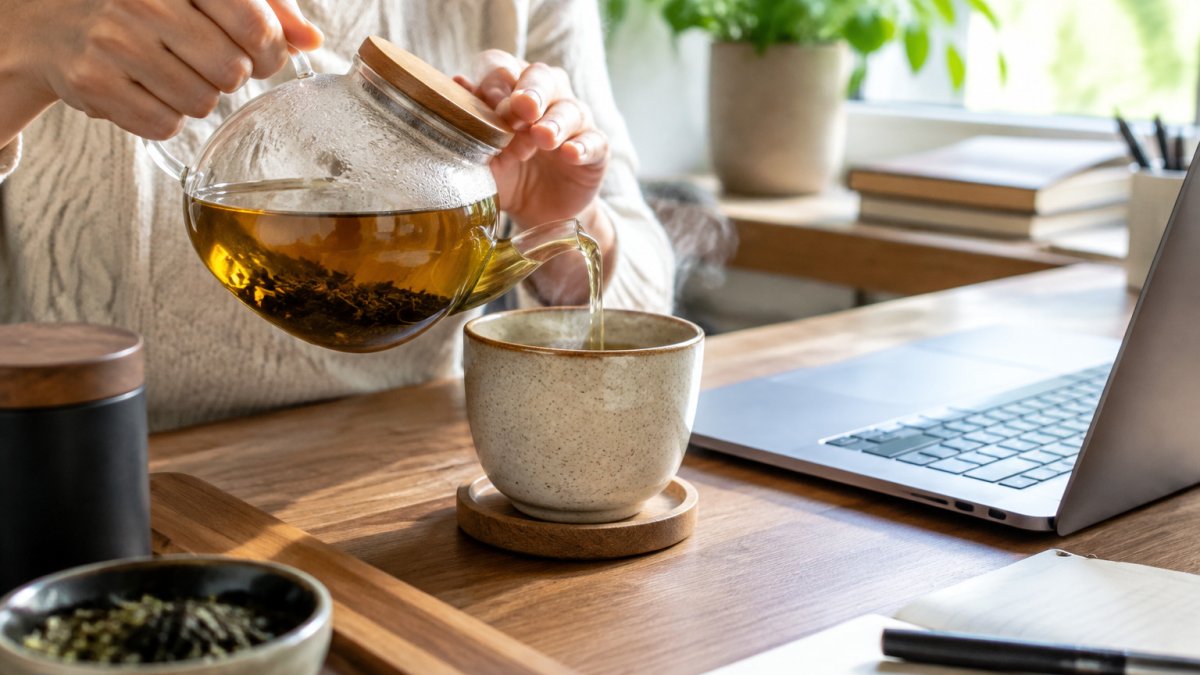
Matcha, stone-milled and whisked into a frothy cup, has a smooth, velvety character as described in its listing. Masala Chai and Earl Grey are built on black-tea bases and are full-bodied in character. Earl Grey's bergamot and cornflowers give it a bright citrus edge, while Masala Chai is rich and spiced.
Gifting Options: Building a Premium Tea Gift Set
The simplest approach to gifting is to assemble your own selection from the individual teas. Pairing two or three contrasting cups, such as Earl Grey for classic flavor, Peach Paradise for a caffeine-free fruit option, and Matcha for a ceremonial touch, gives a recipient variety without requiring a single bundled product.
Matcha is priced at $22.99 and the other listed teas at $23.99, so a three-tea assortment is straightforward to budget. Including a note about the caffeine profile of each tea helps the recipient choose when to drink each one.
What Wellness Claims Can and Cannot Promise
Wellness wording on a tea listing is doing two different jobs at once, and anyone comparing premium tea delivery needs to separate them. One job is describing sensory experience: a tea can credibly be called aromatic, smooth, brisk, or refreshing, and those are statements about taste you can verify in the cup. The other job is implying a health outcome, and that is where labels get loose. A phrase like "supports calm" or "promotes balance" is not a measured effect; it is positioning. The product pages in this lineup describe flavor and ingredients, and you should still know how to audit any tea you buy, including these.
Use four checks, in this order, before you let wellness language influence a purchase.
1. Ingredient disclosure. A transparent listing names every component, including the base tea or herb, the flavoring source (real fruit, botanical, or "natural flavor"), and any added sweetener or oil. Vague entries like "spice blend" or "natural flavors" without a source are a signal to ask questions. For the blends here, you can see the named components, rooibos with cinnamon and orange peel in Apple Cider Rooibos, peach, cranberry, and rose in Peach Paradise, which is the level of specificity to expect.
2. Organic certification. "Organic" is a regulated term in the United States, not a mood. A genuinely organic tea should carry a certifier's mark and a certificate number that you can check with the certifier. If a listing says "organically grown" but shows no seal or certifier, treat it as a growing claim, not a certified one. Ask the seller which certifier audited the farm and when.
3. Origin traceability. Premium tea is agricultural, and origin affects both flavor and risk. A strong listing tells you the country and, ideally, the region or garden, plus the harvest season. If a blend combines teas from multiple origins, the seller should be willing to say so. Traceability is also your best proxy for freshness: tea has a harvest year, and older leaf flattens in aroma.
4. Testing and safety documentation. For herbal blends especially, ask whether the seller tests for heavy metals, pesticide residues, and microbial contamination, and whether results are available on request. You do not need a lab report for every tin, but a seller who cannot describe any testing program is asking you to trust the label alone.
On the evidence side, be precise about what is established and what is traditional. Caffeine is well documented as a stimulant, which is why the caffeine profile of each tea matters more than any wellness adjective. Beyond that, many herbs have long traditional use, rooibos and hibiscus as pleasant caffeine-free infusions, mint for a cooling cup, but traditional use is not the same as proven clinical effect. If a seller ever implies that a tea treats or cures a condition, treat that as a reason for caution.
Watch out: herbal blends are not automatically risk-free (Herb-Drug Interactions). Some botanicals can interact with medications, and pregnancy, nursing, allergies, and caffeine sensitivity all change what is appropriate for you. Check with a healthcare professional before adding a new herbal tea to a routine, especially if you take prescription medication or manage a diagnosed condition.
Choosing Your First Order from Shamballa Caffe
A first order from a premium tea delivery service is really a delivery decision, not just a flavor decision, so treat it like one. The lineup is priced simply, Matcha at $22.99 and the other teas at $23.99, which means the variable that changes your experience most is how and how often the tea arrives, and what each cup actually costs you.
Start with caffeine and time of day, because that filters the list fastest. For a daytime cup, Hojicha and Matcha are the gentle-to-focused green options, while Masala Chai and Earl Grey bring a stronger black-tea base. For evenings, Apple Cider Rooibos, Peach Paradise, and Hibiscus Berry Tea keep caffeine out of the picture. A practical first move is two contrasting teas, one caffeinated, one caffeine-free, so you learn which style fits your routine before committing to more.

Then run the delivery questions that product listings usually skip. Use the same five checks for any tea seller, including this one:
- Frequency and commitment. Is delivery one-time, monthly, or every few weeks, and is there a minimum number of shipments? A flexible schedule matters more than a discount if you drink two cups a day versus two a week.
- Box contents and customization. Can you choose specific teas, or does the seller pick? Can you swap a tea you dislike, pause a shipment, or skip a month? Customization is the difference between a subscription you use and one you cancel.
- Cancellation terms. Find the cancellation window and whether it must be done before a cutoff date. A plan you can stop in one step is worth more than a slightly cheaper one with a lock-in.
- Shipping cost and timing. Confirm the shipping charge, whether it is flat or free above a threshold, and the typical transit time. Shipping can quietly erase a per-cup savings.
- Per-cup value. Divide the tin price by the number of servings you actually get. For example, if a tin yields a given number of cups, divide its price by that count to compare per-cup cost. Compare those figures across sellers rather than comparing sticker prices, because tin sizes differ.
A simple way to decide: if you drink tea daily, a recurring delivery with a skip option usually beats one-time orders because you avoid running out and can pause when you travel. If you are still exploring, start with a single order of two teas, note which one you finish first, and let that tell you what to reorder. Keep the caffeine profile of each tea written on the tin or in a note, so the recipient or future you can choose the right cup at the right hour.
Watch out: per-cup math only works if you know the serving count. Confirm how many cups a tin is expected to make before you compare a $22.99 Matcha against a $23.99 blend.
Frequently Asked Questions
What are the top premium tea brands?
Premium tea is usually judged on sourcing, leaf quality, and how transparent a seller is about its ingredients. Shamballa Caffe's catalogue includes matcha, hojicha, jasmine, Earl Grey, masala chai, and several fruit and herbal blends, all listed at $22.99 to $23.99. When comparing any brand, check whether the listing names the tea origin, the leaf style, and the full ingredient list. Shamballa Caffe's listings name ingredients such as Ceylon black tea, bergamot oil, and organic rooibos, which makes side-by-side checks straightforward.
What are the best teas for wellness?
The best tea for you depends on the effect you want, and tea is not a treatment for any condition. For a calm evening routine, a caffeine-free option such as Apple Cider Rooibos or Peach Paradise suits many people. Green teas such as Jasmine or Moroccan Mint are one option for a daytime cup. Anyone who takes medication, is pregnant, or has a medical condition should check with a doctor before adding new herbal blends.
Are tea subscription boxes worth it?
A tea subscription is worth it if you drink through a tin or pouch every week and want variety without reordering. Shamballa Caffe's teas are priced at $22.99 to $23.99 each, so compare the per-serving cost of a recurring plan against single orders before committing. Check the cancellation terms and delivery frequency before signing up, and start with one or two blends to confirm you enjoy the flavor profile.
