


9 Essential Coffee Accessories for Home Baristas
Last Updated: October 30, 2026
Quick Summary
The best coffee accessories for a home barista are a digital scale that reads to 0.1 gram, a burr grinder, a tamper matched to your basket, a distribution tool, a milk pitcher sized to your drinks, a knock box and an airtight storage container. Buy the scale and grinder first, because they control dose and grind consistency, the variables that most affect flavor.
- Look for a scale that reads to 0.1 gram to hold dose steady and track the brew ratio.
- A burr grinder produces more uniform particles than a blade grinder, which is the foundation of good espresso.
- Match tamper diameter to your basket, since a mismatched tamper lets water channel through gaps at the edges.
- Pick a milk pitcher sized to the drinks you make, such as 12 ounces for a single latte or 20 ounces for one 12-ounce drink.
- Store beans in an airtight, opaque container at room temperature and avoid repeatedly opening frozen bags.
Table of Contents
- Coffee Scales for Brewing: Dosing Accuracy You Can Measure
- Espresso Accessories That Improve Workflow and Consistency
- Milk Pitchers, Tampers and Other Home Barista Tools by Budget
- Recommended Brewing Accessories Beyond Espresso
- Storing Beans and Grounds to Keep Them Fresh
- Building Your Starter Kit: Where to Begin
- Frequently Asked Questions
Most home coffee setups fail for the same reason: the machine gets the money and the accessories get forgotten. A good espresso machine is only as consistent as the dose, grind and milk that go into it.
Think of accessories as the tools that make your results repeatable. A scale tells you how much coffee went into the basket. A tamper packs it evenly. A milk pitcher gives you control over texture. Without them, you are guessing, and guessing is why one morning's shot tastes sharp and the next tastes flat.
The biggest mistake is buying a machine and stopping there. Many new owners assume the machine does the hard work. In practice, the variables that change flavor are upstream of the machine: grind size, dose weight and how evenly the coffee is distributed. Accessories are how you manage those variables.
A digital scale is a strong first purchase, because it turns vague habits into measurable numbers you can adjust. Coffee is a commodity that changes by the day as beans age, so measurement is the fastest path to consistency.
Below, we cover the accessories that matter most, how to spend by budget, and where to start if you want a prioritized kit rather than a random pile of gear.
Coffee Scales for Brewing: Dosing Accuracy You Can Measure
A coffee scale is the single most useful accessory for a home barista. It measures your dose in grams, which is far more reliable than scooping by volume. Scoops vary with grind size and how densely the coffee packs, so the same scoop can deliver noticeably different doses.
Look for a scale that reads to 0.1 gram. That resolution lets you hold the dose steady from shot to shot and track the brew ratio, the relationship between coffee in and espresso out. A timer built into the scale is a practical bonus, since shot time is one of the main levers you adjust when dialing in.
For pour-over and filter brewing, the same scale handles the water weight. Weighing water keeps your brew ratio consistent even when you change equipment. A digital scale with a flat, wide platform is easier to use with a cup or carafe sitting on it.
Common mistake: buying a scale that only reads to 1 gram. At espresso doses, one gram is a large error, and it undermines the consistency the scale was supposed to create.
Espresso Accessories That Improve Workflow and Consistency
Espresso is the most demanding brewing method for home use, and it rewards good workflow. The core accessories are a grinder, a tamper, a distribution tool and a way to handle spent pucks cleanly.
A burr grinder is the most important of these. Grind consistency strongly influences extraction. Blade grinders chop beans unevenly, which produces fines and boulders in the same batch and leads to shots that taste bitter and sour at once. Burr grinders produce a more uniform particle size, which is why most home baristas treat one as the foundation of the setup.
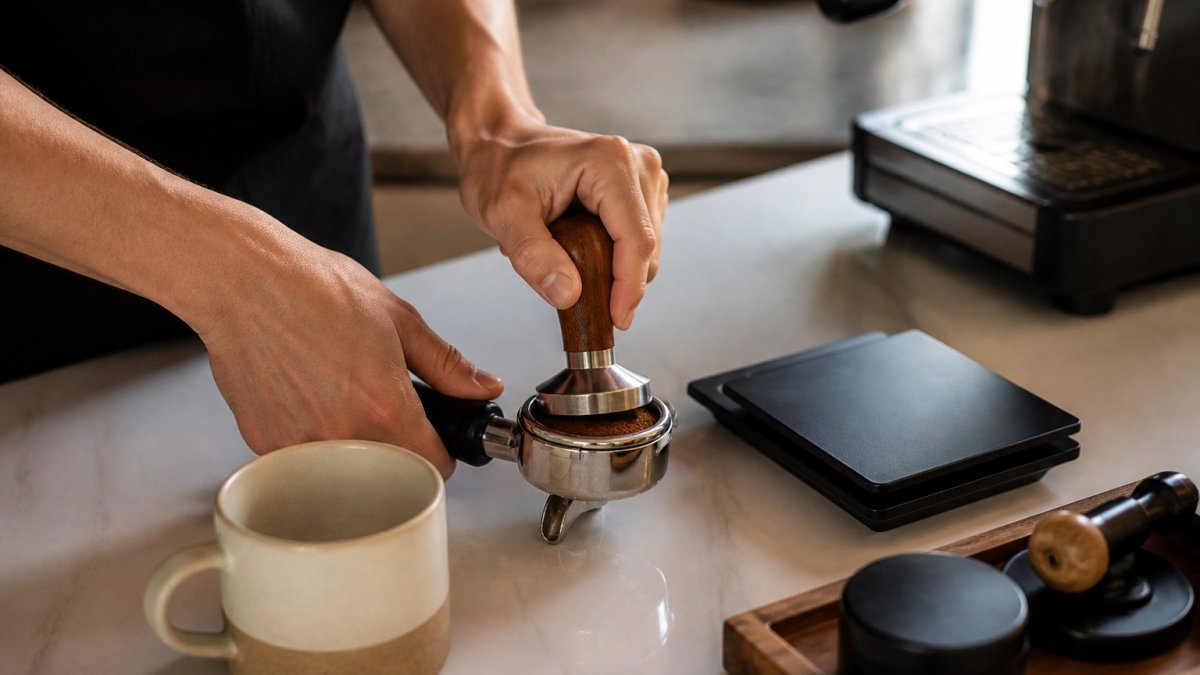
A tamper compresses the coffee in the basket. Look for a flat base that matches your basket diameter. A mismatched tamper leaves gaps at the edges, and water channels through those gaps. Pair it with a tamping mat or a stable counter so the tamp stays level.
A distribution tool or a simple leveling tap helps spread grounds evenly before you tamp. Uneven distribution is one of the most common causes of channeling. These tools cost little and fix a problem that is easy to overlook.
For cleanup, a knock box keeps spent pucks contained and protects your counter. It is a small purchase that makes the routine faster and tidier.
| Accessory | Main Job | Budget Range | Priority |
|---|---|---|---|
| Digital scale | Accurate dose and ratio | Low to mid | Highest |
| Burr grinder | Consistent grind | Mid to high | Highest |
| Tamper | Even compression | Low | High |
| Distribution tool | Even grounds layer | Low | Medium |
| Knock box | Puck disposal | Low | Medium |
Milk Pitchers, Tampers and Other Home Barista Tools by Budget
Budget matters, so here is how to spend at three levels. The goal is to buy the tools that improve results most for the money, and to avoid paying for features that do not change what is in your cup.
Milk pitchers deserve a specific note because sizing mistakes are common. Match pitcher capacity to the drink and the steam wand:
- 12-ounce pitcher: best for a single 6-8 ounce latte or flat white; small enough that the wand stays submerged without the milk climbing the walls.
- 20-ounce pitcher: the workhorse for one 12-ounce drink or two smaller ones; a common default for home machines.
- 32-ounce pitcher: useful only if you regularly steam for two or more drinks at once; on a low-power home wand it can take too long and over-aerate the milk.
Stainless steel is durable and easy to clean, and the spout shape affects how easily you pour latte art. A pitcher with a sharp, tapered spout gives more control than a rounded one. Choose the pitcher you will actually use daily, and buy a second in the size you reach for most so you are not washing between drinks.
Tamper sizing is the other place beginners lose money. Tampers are sold by diameter, and the base must match your basket, commonly 51 mm, 53 mm, 54 mm, or 58 mm depending on the machine. A 58 mm tamper in a 54 mm basket leaves a ring of untamped coffee at the edge, and water channels through it. Measure your basket's inner diameter before buying, or buy from a seller who lists the compatible basket size. A tamping mat or a stable counter keeps the tamp level; a level tamp matters more than a fancy handle.
Recommended Brewing Accessories Beyond Espresso
Espresso is not the only method, and the accessories you need depend on how you brew.
Pour-over: A gooseneck kettle gives control over water flow, and a scale keeps the brew ratio steady. A 0.1-gram scale with a timer is more useful here than a fancy kettle, because pour-over rewards consistent ratios more than perfect pouring.
French press: A coarse grinder setting matters more than any single tool, and a scale still helps with dose and water. A 32-ounce press is the common home size; a 12-ounce press suits one mug.
AeroPress: The brewer itself is the accessory, and it is compact enough for small kitchens. A scale and a timer matter more than anything else; a stirrer or paddle helps with even extraction. AeroPress rewards a medium-fine grind, which most burr grinders handle well.
Cold brew: A large container with a fine filter and a scale for the coffee-to-water ratio cover the basics. A 1-quart jar or a dedicated cold brew maker handles a week of concentrate; a 2-quart container suits households that drink it daily.
Compatibility matters here, and it is where most buying mistakes happen. A grinder that dials fine enough for espresso can also handle pour-over, while a coarse-only grinder will not.
Our recommendation: if you brew several ways, buy a grinder with a wide range first, then add method-specific tools. That order avoids buying a second grinder later.
Storing Beans and Grounds to Keep Them Fresh
Freshness is the variable most home baristas overlook. Coffee loses aromatic compounds after roasting, and oxygen, light, heat and moisture speed that loss. Storage accessories protect the investment you have already made in good beans.
An airtight, opaque container is the basic need. Keep beans in it at room temperature, away from the stove and sunlight. Buy amounts you can use within a few weeks, and keep only what you need in the grinder hopper. Ground coffee goes stale faster than whole beans, so grind close to brewing time.
Look for a container with a one-way valve if you buy roasted beans in bulk. The valve releases carbon dioxide without letting air in. A scoop that fits the container keeps your hands and the beans dry.
Common mistake: storing beans in the freezer and opening the bag repeatedly. Condensation forms when cold beans warm, and moisture ruins flavor. If you freeze, portion the beans first and thaw only what you need.
Building Your Starter Kit: Where to Begin
If you are starting from zero, buy in this order:
- Digital scale (0.1 gram resolution): Establishes your dose and ratio.
- Burr grinder: Gives you consistent particle size, which is the foundation of good espresso.
- Tamper matched to your basket: Compresses evenly.
- Distribution tool: Spreads grounds before tamping.
- Milk pitcher sized to your drinks: Enables steaming.
- Knock box: Keeps spent pucks tidy.
- Airtight storage container: Protects beans between purchases.
Start with the scale and grinder, then add the rest as your routine develops. This sequence delivers the largest quality gain for the money at each step.
Shamballa Caffe's own range can complement this kit. Our Mug with Color Inside ($19.69), a ceramic mug with a colorful rim, handle and interior, is a practical vessel for the drinks you make. The Travel Mug with a Handle ($46.75) is made with stainless steel and suits taking drinks on the go; it is hand-wash only. The Enamel Mug ($27.50) should not be used to heat liquids or food directly.
Once your kit is in place, the next step is learning to brew consistently. For a complete walkthrough, read How to Brew Better Coffee: A Guide to Better Mornings.
Frequently Asked Questions
What accessories does a home barista need?
A reliable home barista setup starts with a burr grinder, a digital scale that reads to 0.1 gram, a tamper that fits your portafilter, and a milk pitcher if you drink lattes or cappuccinos. A knock box and a distribution tool are useful next additions because they make each shot more repeatable. Shamballa Caffe's Mug with Color Inside ($19.69) and White glossy mug ($14.30) are ceramic mugs for serving finished drinks. Prioritize the tools that control dose, distribution and timing, since those variables affect flavor most.
Do home baristas need a coffee scale?
Yes. Weighing your coffee dose and your water output is the simplest way to get consistent results from one brew to the next. Volume measurements like scoops vary with grind size and bean density, while grams do not. A scale with 0.1-gram accuracy helps you track brew ratios and shot timing, and it lets you adjust one variable at a time when a brew tastes sour or bitter. For most home setups, a compact scale with a timer is enough.
What should a beginner buy for a home coffee bar?
Start with the tools that affect the most variables: a burr grinder for grind consistency, a digital scale for dosing, and a tamper sized to your portafilter basket. Add a milk pitcher once you start steaming milk regularly. Skip specialty gadgets until you have a repeatable routine. Cleaning equipment such as a grinder brush and a backflush detergent also extends the life of your machine and keeps flavor clean from shot to shot.
How do you keep coffee beans fresh at home?
Store whole beans in an airtight, opaque container away from heat, light and moisture. A coffee storage container with a one-way valve helps release gas from freshly roasted beans without letting in air. Buy beans in quantities you can use within a few weeks of the roast date, and grind only what you need for each brew. Grinding just before brewing preserves more aromatic compounds than pre-ground coffee.
